Every growing team reaches a point where laptops become a planning problem. In the early days, devices were bought one at a time. A new hire joins, and a laptop is ordered. Someone upgrades when performance drops. Old machines are kept as backups.
This approach works until hiring speeds up. Teams expand across locations. Device management starts consuming time. Costs become harder to predict.
At this stage, businesses usually compare two options: continue buying laptops outright or shift to structured laptop rental services.
How Buying Laptops Typically Starts
Buying laptops feels straightforward. The business owns the device.
For small teams, this offers flexibility. Devices can be selected based on individual preferences. Procurement is informal. There is little coordination required.
As headcount increases, this simplicity fades. Different models enter the system. Specifications vary. Warranty timelines differ. Tracking assets becomes manual.
What once felt easy starts to slow operations.
Ownership Comes With Ongoing Responsibility
Owning laptops means owning every issue that follows — repairs, interruptions, and replacements are handled internally.
When a device fails, productivity drops immediately. Temporary devices are shared. Deadlines slip.
Buying laptops transfers full responsibility to the business. This responsibility grows with team size and often overlaps with broader IT infrastructure management handled through solutions like managed workplace support.
What Laptop Rental Services Change
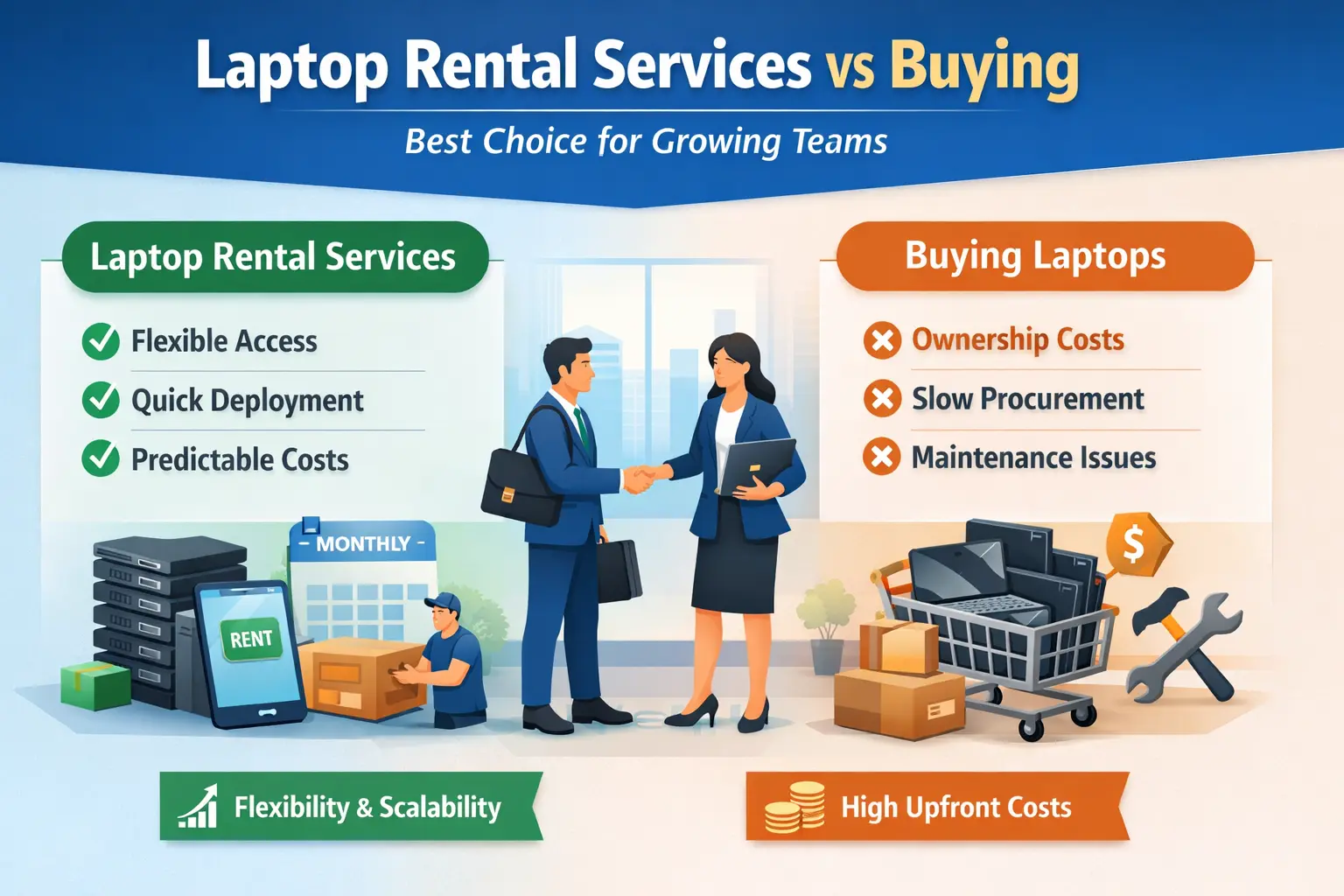
Laptop rental services shift device management from ownership to access. The business uses the laptops without managing their full lifecycle.
Devices are provided based on need. Setup, replacement, and support are handled by the service provider. When a laptop fails, it is replaced. When a role ends, the device is returned.
For growing teams, this removes friction without changing how employees work.
Speed Matters During Hiring
Hiring cycles often move faster than procurement. New employees need devices on day one. Delays slow onboarding.
Buying laptops requires lead time. Stock availability varies. Configuration takes effort. Delivery timelines are unpredictable.
Laptop rental services reduce this delay. Devices are provisioned quickly through structured deployment processes similar to other scalable business IT solutions. Standard configurations are ready. Onboarding becomes smoother.
This matters when teams are scaling under time pressure.
Cash Flow and Cost Structure
Buying laptops requires upfront capital. Costs spike when multiple devices are purchased together. Budget planning becomes uneven.
With laptop rental services, costs are spread over time. Monthly expenses are predictable. Large upfront payments are avoided.
For growing businesses, this structure supports cash flow management. Spending aligns more closely with team size.
Managing Device Diversity
As teams grow, laptop diversity increases — different brands, operating systems, and performance levels.
This creates support challenges. Software behaves differently. Accessories vary. Troubleshooting becomes inconsistent.
Laptop rental services often standardise device configurations. Teams work on similar setups. Support becomes simpler. Compatibility issues are reduced.
This consistency supports operational stability.
Handling Short-Term and Contract Roles
Not all roles are permanent. Interns, contractors, and project-based hires join for limited periods.
Buying laptops for short-term use creates waste. Devices sit unused after projects end. Asset tracking becomes messy.
Laptop rental services fit short-term needs well. Devices can be issued and returned based on duration. The business pays only for the time the laptop is used.
This flexibility reduces idle assets.
Maintenance and Downtime
Laptop failures disrupt work quietly. Screens crack. Batteries degrade. Performance drops.
With owned devices, repairs take time. Employees wait or switch devices. Productivity suffers.
Laptop rental services handle maintenance externally. Faulty devices are replaced quickly. Downtime is reduced.
This keeps teams productive without internal coordination.
Security and Data Handling
Laptops carry sensitive data — customer information, internal documents, and credentials.
When employees leave, owned laptops must be wiped and secured. Mistakes create risk.
Many laptop rental services include data sanitisation as part of the return process, aligning with structured device lifecycle practices found in modern enterprise IT environments. Devices are reset before reuse.
This reduces exposure without adding internal steps.
Scaling Without Rebuilding
Growth rarely follows a straight line. Teams expand in phases. Some departments grow faster than others.
Buying laptops requires repeated procurement cycles. Each phase adds more devices with different timelines.
Laptop rental services scale more smoothly. Devices are added or removed as headcount changes. The overall setup remains consistent.
This supports growth without repeated redesign.
Asset Tracking and Visibility
Tracking owned laptops becomes harder as numbers increase — who has which device, when warranties expire, and which laptops need replacement.
This information often lives in spreadsheets. Accuracy declines over time.
Laptop rental services centralise tracking. Devices are monitored by the provider. The business retains visibility without manual effort.
This reduces administrative overhead.
When Buying Still Makes Sense
Buying laptops can work for stable teams with slow growth. If roles are long-term and device usage is predictable, ownership may be practical.
Some specialised roles also require custom hardware that rental providers may not offer.
These cases are specific. They do not apply to most growing teams.
Choosing What Works Better
The decision between buying and renting depends on growth speed, team structure, and tolerance for operational load.
Buying offers ownership but increases internal responsibility.
Laptop rental services offer flexibility, predictability, and reduced management effort.
For businesses focused on scaling teams rather than managing hardware, rental models often fit better.
Frequently asked questions (FAQs)
Laptop rental provides flexibility and lower upfront costs, while purchasing offers long-term ownership and control over assets.
Yes, many enterprises choose rental solutions for long-term use as they reduce capital expenditure and allow easy upgrades.
Absolutely. Rental solutions make it easy to scale devices up or down based on workforce and project requirements.
Most rental providers offer enterprise-grade devices with security configurations to ensure safe business operations.
It depends on business needs — renting is often more cost-effective for dynamic teams, while buying may suit stable, long-term infrastructure needs.